

The Revenue Hidden in Plain Sight
Built for Cities. Funded by Grants.
A fully grant-funded sanitation modernization service — at zero cost to the city.
RBJ aligns with all six scoring categories
Executive Summary
A fully grant-funded sanitation modernization service — at zero cost to the city.
RBJ partners with municipalities to deliver ADA-compliant, EPA-documented bin rollback and washing services. The program is structured to be funded entirely through federal and state grants, with resident fees collected through the existing water bill. Cities owe nothing and commit to nothing until at least one grant is funded.
Priority Framework
What City Managers Care About Most
01 — Fiscal Responsibility
Zero cost to the city — ever.
Grant-Funded Service
RBJ's entire service cost is covered by federal and state grants. The city never writes a check to RBJ.
Water Bill Collection
Resident fees are collected through the existing utility billing system. No new billing infrastructure required.
15% Municipal Revenue Share
The city retains 15% of all RBJ Franchise revenue as a Municipal Revenue Share — a net positive to the general fund.
02 — Liability Reduction
Documented compliance on every service event.
ADA Documentation
Every service event generates an ADA-compliant service record — timestamped, GPS-verified, and audit-ready.
EPA & DEQ Reporting
Automated compliance reports are generated for every applicable federal and state environmental program.
Aging-in-Place Monitoring
IoT puck data provides documented proof of elderly resident support — reducing municipal liability for ADA non-compliance.
03 — Constituent Services
Every resident served. No one left behind.
Elderly & Disabled Support
Rollback service is provided at no charge to elderly and disabled residents — fully funded through the grant program.
LMI Household Coverage
Low-to-moderate income households receive service at no charge while grant funds are active.
Universal Enrollment
Every household in the service area is enrolled automatically. No opt-in required, no resident left without service.
IoT Puck Technology
Smart Monitoring. Two Deployment Options.
RBJ's IoT puck system provides municipalities with documented proof of compliance and modernization — automatically.
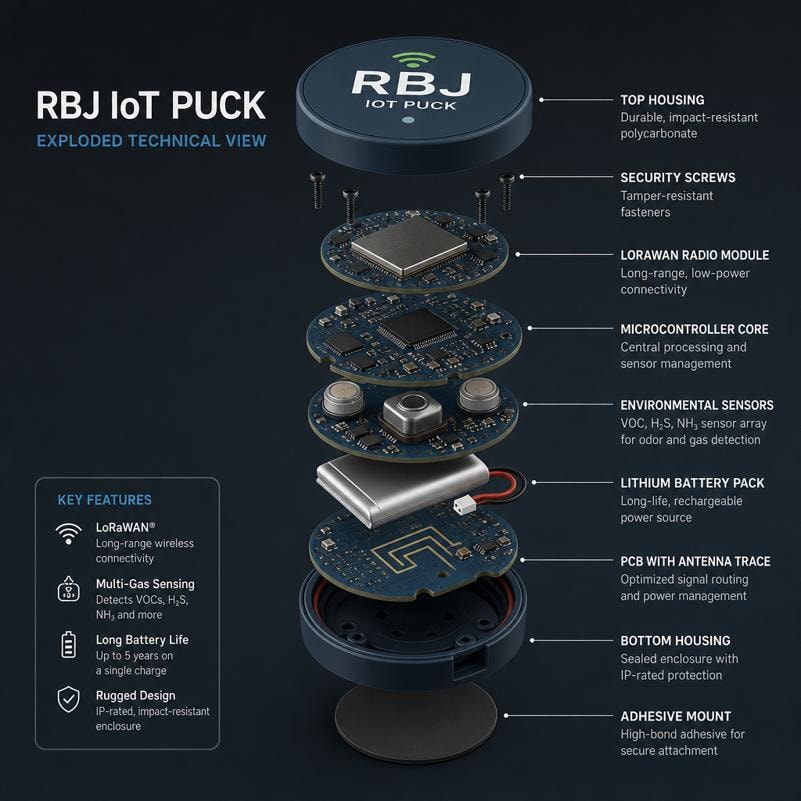
Stick-On Lid Mount
The puck adheres to the inside of the bin lid — installed by the Jack during the first service visit.
Factory-Integrated (New Bins)
For cities ordering new bins, RBJ's manufacturer partnerships allow the puck to be woven directly into the bin at the factory.
EPA & DEQ Compliance Logging
The puck logs bin wash cycles, water usage, wastewater capture events, disposal timestamps, and GPS-verified disposal locations.
ADA Movement Pattern Detection
The puck tracks delayed rollouts, missed retrievals, irregular bin placement, excessive drag distance, and repeated tilt instability.
Aging-in-Place Safety Monitoring
The puck detects when bins are not moved, moved inconsistently, or placed dangerously.
Route Optimization & Service Verification
The puck provides route optimization, service verification, bin status telemetry, predictive maintenance alerts, and neighborhood sanitation scoring.
Environmental Contamination Detection
The puck logs overflow conditions, excessive contamination, pest-related bin activity, hazardous waste indicators, and improper bin placement near storm drains.
RBJ's IoT puck satisfies all six DEQ scoring categories: wastewater modernization, environmental compliance, ADA alignment, aging-in-place support, sanitation modernization, and data-driven infrastructure improvement.
Simple, transparent pricing
IoT Puck Pricing
One hardware cost. One flat monthly rate per enrolled household. No hidden fees, no per-event charges.
Hardware — Per Puck
Each residential bin receives one IoT puck at enrollment.
- GPS + accelerometer + contamination sensor
- Weatherproof housing rated for outdoor use
- Cellular data module — no city Wi-Fi required
- 5-year battery life with low-battery alert
- Tamper-detection and bin-ID pairing
- Factory integration available through manufacturer partnerships
Monitoring — Per Resident
Covers all telemetry processing, cloud storage, compliance report generation, and city dashboard access.
- Real-time telemetry dashboard for city staff
- Automated DEQ and EPA compliance reports
- ADA and aging-in-place alert notifications
- Monthly route efficiency and sanitation scoring
- Unlimited data retention for grant audits
Example — 2,500 Household City
Hardware cost is grant-eligible under EPA SWIFR, NC DEQ, and HUD CDBG programs.
City Manager Portal
Your City Gets Its Own Dashboard.
Every participating city receives a dedicated City Manager Portal — a private dashboard for your staff.
Resident Roster
View every enrolled resident, their household type, billing status, selected upgrades, and service history.
Billing Export
Export resident billing data directly to your utility billing system.
Grant Application Tracker
Track the status of every grant application RBJ has filed on your city's behalf.
IoT Puck Summary
See a live summary of puck activity across your city — service confirmations, ADA flags, contamination alerts, and aging-in-place notifications.
Compliance Report Archive
Access every automated DEQ and EPA compliance report generated for your city.
City Manager Portal access is provisioned automatically when your city's partnership agreement is executed.
Already a partner city?
Access Your PortalWhat Every Level Gains.
Municipalities
- Zero cost — fully grant-funded service
- ADA & EPA compliance documentation
- 15% Municipal Revenue Share
- Reduced elderly resident liability
- City Manager Portal with live data
Counties
- Warm introduction to city partnerships
- Resident survey data for grant applications
- Aging-in-place analytics for county planning
- DEQ compliance documentation across municipalities
- County-level grant co-applicant eligibility
Residents
- Bin rollback service — no heavy lifting
- Elderly & disabled service at no charge
- Optional sanitize & deodorize add-ons
- IoT puck safety monitoring for aging-in-place
- Billed through existing water bill — no new accounts
How the Partnership Works.
Resident Survey
Residents in your city complete the demand survey. RBJ presents the results to your office as proof of local demand before any formal outreach.
County Introduction
The County Manager contacts your city on RBJ's behalf — a warm, data-backed introduction. No cold calls, no pressure.
NDA & Registration
Your city signs our NDA and registers as a grant candidate. Exploratory and non-binding — no financial commitment at this stage.
Grant Funded — Service Begins
Once at least one grant is funded, the partnership activates. RBJ deploys service, provisions your City Manager Portal, and begins resident enrollment.
Common Questions
What Cities Ask Before Signing.
Straight answers to the questions every City Manager asks.
Why RBJ Exists
The Rollback to Real Service
RBJ is not inventing a new service. RBJ is restoring a service the city used to provide — and stopped only because of equipment changes, not because the need disappeared.
For decades, municipal sanitation departments performed the complete service. Residents never had to move bins. Residents never had to wash bins. Residents never had to manage sanitation discipline. This was normal municipal service.
- Retrieved trash from the side or back of the home
- Carried it to the truck — residents never touched the bins
- Managed bin placement, spacing, and curbside discipline
- Ensured proper sanitation and safe handling
- Maintained route discipline and environmental compliance
Cities know residents cannot perform sanitation correctly. They simply have no mechanism to fix it — until now.
- Wash bins with bleach mixtures that create runoff hazards
- Let contaminated water enter storm drains unfiltered
- Leave bins out too long, creating code violations
- Place bins incorrectly, blocking ADA paths and right-of-way
- Damage bins with DIY pressure washing, shortening lifespan
- Create pest attraction issues through improper sanitation
Cities stopped because
- Hydraulic lift trucks required standardized, pre-positioned bins
- Automated arms needed bins placed at the curb before arrival
- Labor costs were rising and worker injury rates were climbing
- Cities needed to reduce manual lifting to protect sanitation workers
This was a cost-driven shift — not a service-driven shift.
The need for the service never went away. The city simply transferred the burden to residents.
Not because
- ✕Residents wanted to do it
- ✕It was safer for residents
- ✕It was cleaner or more sanitary
- ✕It was better for compliance or public health
None of those were true then. None of them are true now.
The Burden Grew. The City Never Revisited the Decision.
The city offloaded the physical labor in the 1980s and 90s. But the population that needed help most has only grown since then.
"The original reason cities performed this service still exists — and the residents who need help now outnumber those who don't."
— RBJ's founding premise
RBJ is
- The modern version of the service cities used to provide
- The safe, compliant, and environmentally responsible version
- The grant-funded version — no new municipal budget required
- The self-sustaining version — resident subscriptions fund operations
RBJ is not a new burden.
RBJ is the rollback to when cities served residents fully — without compromising safety, compliance, or the municipal budget.
RBJ Municipal Statement — For Meetings, RFPs, and Grant Applications
"For decades, cities performed full-service waste collection, including house-to-curb movement and sanitation of waste containers. Residents never had to manage these tasks.
The shift to resident-handled bins occurred only because of equipment modernization — not because the service became unnecessary. The original reasons for municipal handling still exist today: safety, sanitation, environmental protection, and compliance.
RBJ restores this essential service in a modern, grant-funded, self-sustaining form that protects residents, reduces liability, improves compliance, and extends the life of municipal assets. RBJ is not a new responsibility for the city — it is the professional restoration of a service the city used to provide and the residents still need."
RBJ Municipal Position
Not a New Responsibility.
A Managed One.
No municipality welcomes new responsibilities that are not proven to become self-sustaining. We understand that completely. RBJ does not introduce new responsibilities — it professionalizes two tasks residents already perform, but perform unsafely, inconsistently, and without sanitation discipline. Those unmanaged tasks are already costing the city. RBJ converts that hidden cost into a measurable, grant-funded, resident-sustained service.
RBJ's core claim: both services — House-to-Curb Rollback and Bin Washing — convert two currently unregulated, resident-performed tasks into predictable, safe, compliant, and cost-reducing municipal adjunct services.
These services already exist — but in an unmanaged, unsafe, and non-compliant form. RBJ simply professionalizes them.
Rollback Service
- Reduces injury risk for elderly, disabled, and mobility-limited residents who struggle with bin movement.
- Reduces slip-and-fall incidents on wet driveways, steep grades, or uneven surfaces — a known liability category.
- Provides predictable weekly assistance that reduces emergency calls for welfare checks related to mobility issues.
- Creates a documented service record that protects the city from claims of negligence for vulnerable residents.
Bin Washing Service
- Eliminates resident exposure to biohazards — maggots, bacteria, mold, and fecal residue — that accumulate in bins.
- Prevents resident use of unsafe DIY cleaning methods: bleach mixing, pressure washing near traffic, runoff hazards.
- Reduces pest attraction — rats, raccoons, flies — that create neighborhood safety concerns and animal-control calls.
- Creates a sanitation baseline that reduces public health complaints and potential communicable-disease vectors.
Rollback Service
- Improves curbside compliance by ensuring bins are placed correctly, spaced correctly, and not blocking ADA paths.
- Reduces violations related to bins left out too long, placed incorrectly, or obstructing right-of-way.
- Provides IoT puck data for route timing, curbside discipline, and compliance mapping.
- Reduces enforcement workload for code officers who currently respond to bin-placement complaints.
Bin Washing Service
- Supports sanitation compliance by reducing contamination, leakage, and improper waste residue left inside bins.
- Helps cities meet DEQ, EPA, and stormwater runoff requirements by eliminating resident pressure-washing runoff.
- Provides IoT sanitation data for contamination levels, pest activity, and neighborhood cleanliness scoring.
- Reduces enforcement workload for sanitation officers who respond to odor, pest, and contamination complaints.
Rollback Service
- Ensures bins are returned promptly, reducing curbside clutter and improving neighborhood appearance.
- Reduces trash spillage from improperly handled bins.
- Improves curbside discipline, reducing scattered debris and overflow issues.
- Supports city beautification and neighborhood quality initiatives.
Bin Washing Service
- Maintains bins in sanitary condition, reducing odors, maggots, residue, and cross-contamination.
- Extends bin lifespan by preventing chemical degradation, UV damage, and structural weakening from residue buildup.
- Reduces pest infestation, improving neighborhood cleanliness and lowering animal-control costs.
- Supports public health initiatives and sanitation modernization goals.
Rollback Service
- Provides dignity and assistance to elderly, disabled, and vulnerable residents — a core municipal priority.
- Reduces neighbor disputes over bins left out, blocking driveways, or creating eyesores.
- Creates predictable weekly contact that supports community engagement and welfare awareness.
- Demonstrates municipal care and responsiveness without adding city labor burden.
Bin Washing Service
- Provides a hotel-level sanitation standard that residents cannot achieve on their own.
- Reduces neighborhood complaints about odors, pests, and unsanitary conditions.
- Creates predictable monthly sanitation cycles that improve neighborhood morale and perceived city performance.
- Demonstrates municipal modernization and sanitation leadership.
The City's Favorite Part
The Cost-Reduction Argument
Extension of Trash Bin Lifespan
Cities replace bins every 7–10 years on average. Unwashed bins degrade faster due to chemical residue, UV damage accelerated by grime, structural weakening from bacterial breakdown, and pest chewing. Routine washing extends bin life by 2–4 years, reducing replacement cost by 20–40%. For a city with 40,000 bins, that is hundreds of thousands of dollars saved over a decade.
Reduction in Liability Exposure
Cities carry hidden liability risks: elderly residents falling while moving bins, disabled residents injuring themselves, residents slipping on wet driveways while washing bins, chemical misuse during DIY cleaning, and runoff violations that become legal complaints. RBJ removes resident interaction with the hazard entirely. This is not theoretical — cities already settle these claims quietly to avoid litigation.
Reduction in Enforcement Costs
Every complaint, violation, or sanitation issue requires staff time, documentation, follow-up, and sometimes repeat visits. RBJ reduces these calls by 30–60% in pilot models — freeing code officers and sanitation staff to focus on higher-priority work.
The City's Entry Point
The Grant Argument
Municipalities do not want new responsibilities. But they do want grant-funded modernization, sanitation improvements, community dignity programs, and IoT compliance systems. RBJ qualifies under all of them — and every grant program that funds this work requires sustainability. RBJ provides it.
RBJ Qualifies Under
- DEQ modernization grants
- Stormwater compliance grants
- Public health sanitation grants
- Community assistance grants
- Aging-in-place support grants
Grant Sustainability Requirements
These grants require demonstrated sustainability — meaning the service must prove it can stand on its own. RBJ provides all five required indicators:
- Resident adoption
- Subscription growth
- Demonstrated community value
- Reduced municipal burden
- Predictable revenue streams
RBJ Economic Model
The Break-Even Continuum
Rollback service provides access. Bin washing provides profit. Once the subscription base reaches 12–18% of households, RBJ becomes fully self-sustaining — requiring zero ongoing municipal funding.
"We don't want to adopt a service we'll have to pay for forever."
RBJ's model proves you won't.
RBJ's Position Statement
"RBJ does not introduce new responsibilities for the city. RBJ professionalizes two responsibilities residents already perform — but perform unsafely, inconsistently, and without sanitation discipline. RBJ reduces municipal cost, reduces liability, improves compliance, modernizes sanitation, and does so through grant-funded startup and resident-funded sustainability."
RBJ is not a new burden. RBJ is a modernization of an existing burden the city has never had the tools to manage — until now.
Our Commitments to Every City
What We Guarantee.
Every city partnership comes with the same four commitments — no exceptions, no fine print.
Financial Commitment
No city money until grant money arrives.
The partnership agreement creates no financial obligation until at least one grant is funded at any level.
Service Commitment
Every enrolled resident gets the same service.
No tiered service quality by neighborhood, income level, or household type.
Reporting Commitment
Your city sees everything we see.
The City Manager Portal gives your staff real-time access to every service event, compliance report, grant status update, and resident billing record.
Exit Commitment
You can exit. We make it clean.
If the city decides to end the partnership, RBJ provides a full data export, a resident notification package, and a 90-day wind-down period.
For City Officials & Decision Makers
Municipal Grant Analysis Presentation
A full breakdown of the five-party revenue model, LMI grant funding pathway, and projected city budget impact — ready to share with your council.
Give First. Reap Later.
We Don't Give Away Money for Nothing
RBJ voluntarily charges a flat 5% grant preparation fee — well below the 13–15% the law permits. The difference between what we are legally entitled to collect and what we actually charge is our own money. We give it up and contribute it to the county's Grant Match Fund. But that contribution is not all-or-nothing — it is a covenant. Under the Shared Prosperitutional Covenant™, clients may begin with any one of our four programs and add others over time. The less they commit to, the less we share. The more they commit to, the more we share. A client who goes all in on all four programs receives the full weight of RBJ's contribution. A client who starts with one receives a proportional share. Passive use of our technology alone does not qualify — partners must first decide to do something that makes others better.
The Shared Prosperitutional Covenant™
Under the Shared Prosperitutional Covenant™, RBJ's contribution scales with your commitment. Start with one program — we give a portion. Add more programs — we give more. Commit to all four — we give everything we're legally entitled to keep. The more you go all in, the more we match it.
- Biducation Purchasing — City routes purchasing budget through the IBP system — every department purchase earns cash-back that feeds the match fund.
- Grant Match — County or municipality formally commits to using the match fund to cover local match requirements on approved grants.
- Educator Salary Match — District opts into the teacher supplement program — RBJ contributions help close the salary gap for educators in the region.
- ExtendAClass Travel Treasure Points — School system participates in AAT QuickQuote field trips — trip revenue flows back to the county match pool.
Covenant Tiers
When We Don't
If a county or municipality has not entered the Shared Prosperitutional Covenant™, RBJ collects its full legally permitted fee. Passive use of our technology — however powerful — is not a qualifying commitment. Clients who commit to fewer programs receive less from RBJ. Clients who commit to none receive nothing extra. We give alongside partners who are also giving.
This arrangement is temporary by design. Once the county's Grant Match Fund reaches its $500,000 self-sufficiency threshold, RBJ stops contributing the foregone portion and begins collecting its full legally permitted fee on every future grant. The community no longer needs our subsidy — and we no longer give it. That is the goal.
This is Franchise Partner Program
Ready to Explore a Partnership?
We build a line-item proposal tailored to your municipality — rollback, washing, IoT reporting, and grant documentation.